
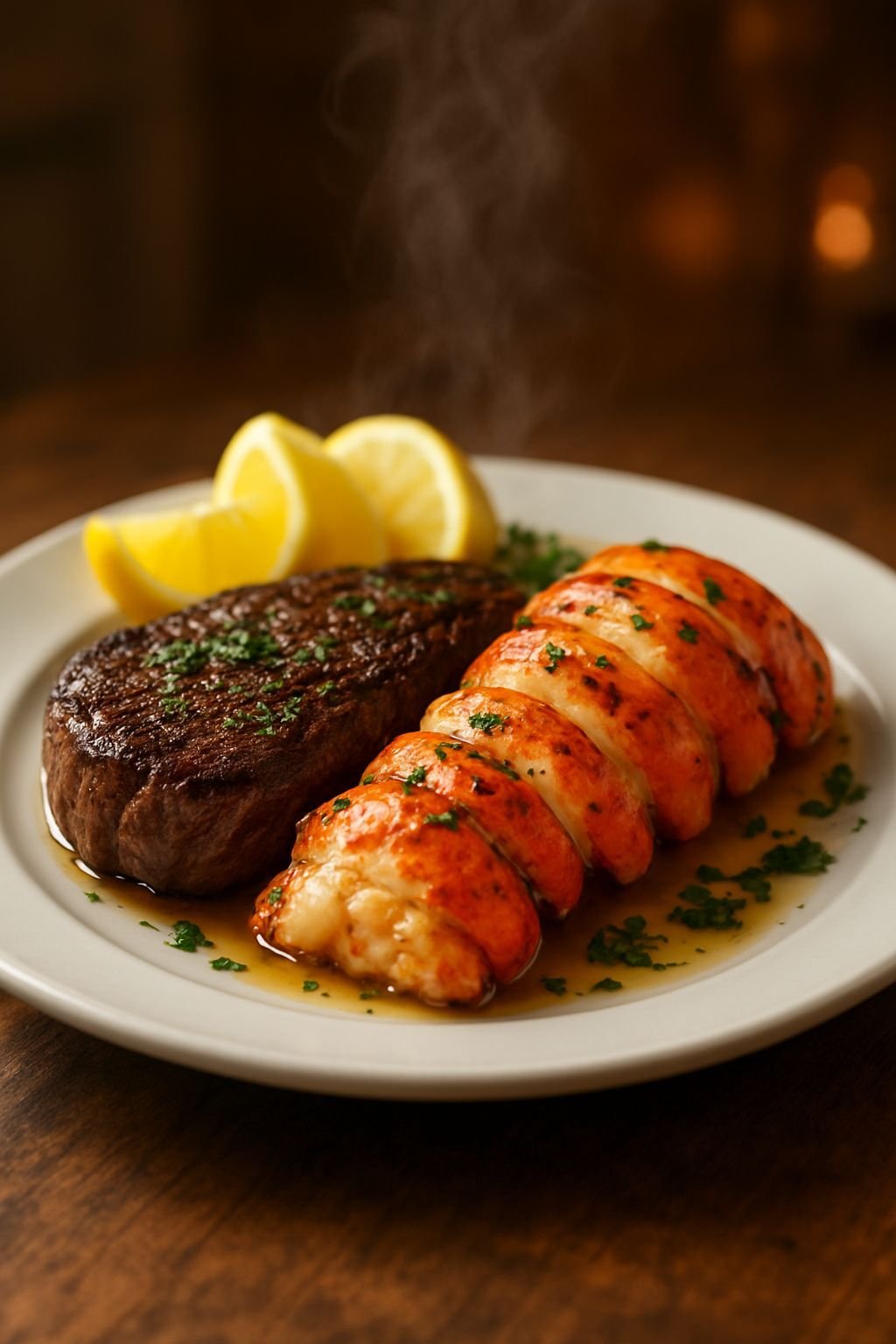
Want restaurant-quality surf & turf at home without stress? Cooking Butter Seared Lobster and Steak in your kitchen gives you superior control over freshness, seasoning, and doneness — plus it’s faster and more affordable than dining out. With a hot pan, a little butter, and a few chef techniques, you’ll turn two everyday proteins into an elegant meal that tastes like it came from a fine dining menu.
Why this recipe works
This Butter Seared Lobster and Steak recipe focuses on simple, high-impact techniques: dry the proteins for a perfect sear, use intense direct heat to build a flavorful crust, finish with butter and garlic for rich aroma and mouthfeel, and rest before serving for juiciness. That control means better flavor and texture than many restaurant meals — and you can tailor everything to dietary needs, budget, or equipment.
Yields, times, and planning
- Yields: 2 servings
- Prep time: 15 minutes
- Cook time: 15–20 minutes
- Total time: 30–35 minutes
Essential ingredients
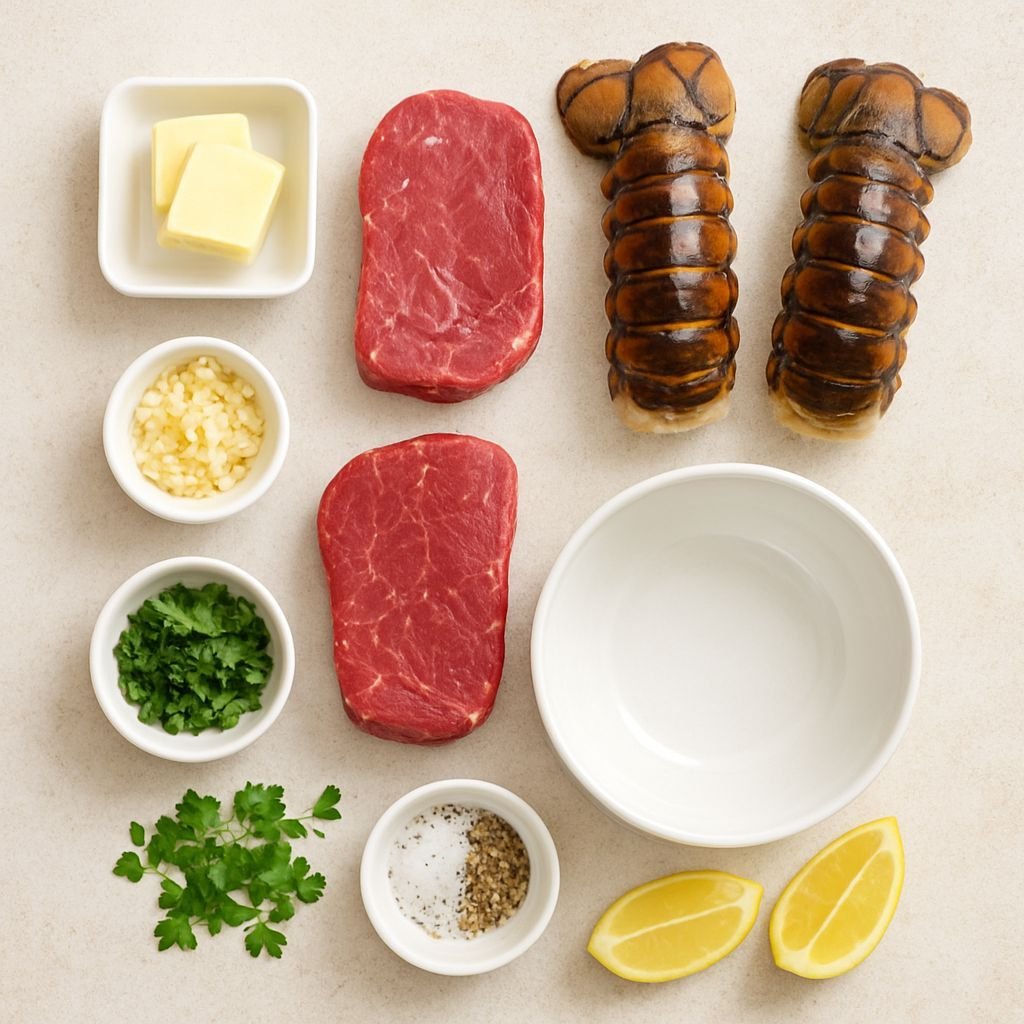
- 2 (6-ounce) lobster tails, thawed (ask your fishmonger to split them if possible)
- 2 (4-ounce) boneless sirloin or ribeye steaks (about 1 inch thick)
- 3 tablespoons unsalted butter
- 2 cloves garlic, minced
- 1 tablespoon fresh parsley, chopped (plus extra for garnish)
- 1/2 teaspoon salt, or to taste
- 1/4 teaspoon black pepper, or to taste
- Optional: Lemon wedges for serving
Optional substitutions and upgrades
- Steak cut: Use striploin (New York), filet mignon, or flank for different textures. Ribeye gives more marbling and richness; sirloin is leaner and more economical.
- Lobster alternative: If fresh lobster tails are unavailable, use thawed frozen lobster tails, large shrimp, or langoustines (scampi). For a shellfish-free alternative, scallops make a great pairing.
- Butter alternatives: Clarified butter or ghee for higher heat stability; olive oil or avocado oil for a dairy-free version; vegan butter for plant-based preferences.
- Herbs and aromatics: Swap parsley for chives, tarragon, or thyme. Add a splash of white wine or lemon juice to the pan sauce for acidity.
- Heat source: Cast iron skillet recommended; you can also use a stainless steel pan, grill, broiler, or air fryer (see variations below).
Necessary kitchen tools
- Heavy-bottomed skillet or cast iron pan (10–12 inches)
- Tongs and spatula
- Sharp chef’s knife and kitchen shears (for splitting lobster)
- Cutting board and paper towels
- Instant-read thermometer (highly recommended for perfect doneness)
- Small mixing bowl for butter sauce
- Aluminum foil for resting steaks
Step-by-step cooking instructions with chef tips
Follow these steps for a dependable, high-impact result. I’ve included chef tips and temperature targets so you can hit ideal doneness every time.
- Prep the proteins (5–7 minutes). Pat both steaks and lobster tails completely dry with paper towels. Remove excess surface moisture — this is crucial for a good sear. Season steaks generously on both sides with salt and pepper. Lightly season the lobster meat with a pinch of salt and pepper only; lobster’s natural sweetness doesn’t need heavy seasoning. Chef tip: Season the steak at least 10 minutes before cooking or just before searing. If you season early, this gives time for salt to draw out some moisture and then reabsorb for better penetration. But don’t leave them sitting wet — always pat dry just before the heat hits.
- Split the lobster tails (if needed) — 3–5 minutes. If the tails are not pre-split, place the tail shell-side up and use kitchen shears to cut down the center of the shell lengthwise. Then, gently pry the shell open and lift the meat up, resting it on top of the shell for even cooking. Leave the tail fin intact for presentation. Chef tip: Use a small knife to loosen the meat from the bottom of the shell before flipping. This helps it cook evenly and makes serving easier.
- Heat the pan — 1–2 minutes. Preheat a large heavy-bottomed skillet (cast iron preferred) over medium-high heat for 2–4 minutes until very hot. A properly preheated pan is the secret to a crusty sear. Add 1 tablespoon of butter and let it melt fully until it starts to foam. Chef tip: For higher smoke-point and less browning risk, melt 1 teaspoon of neutral oil (avocado or canola) first, then add butter for flavor. The oil raises the burn threshold so the butter can caramelize without burning.
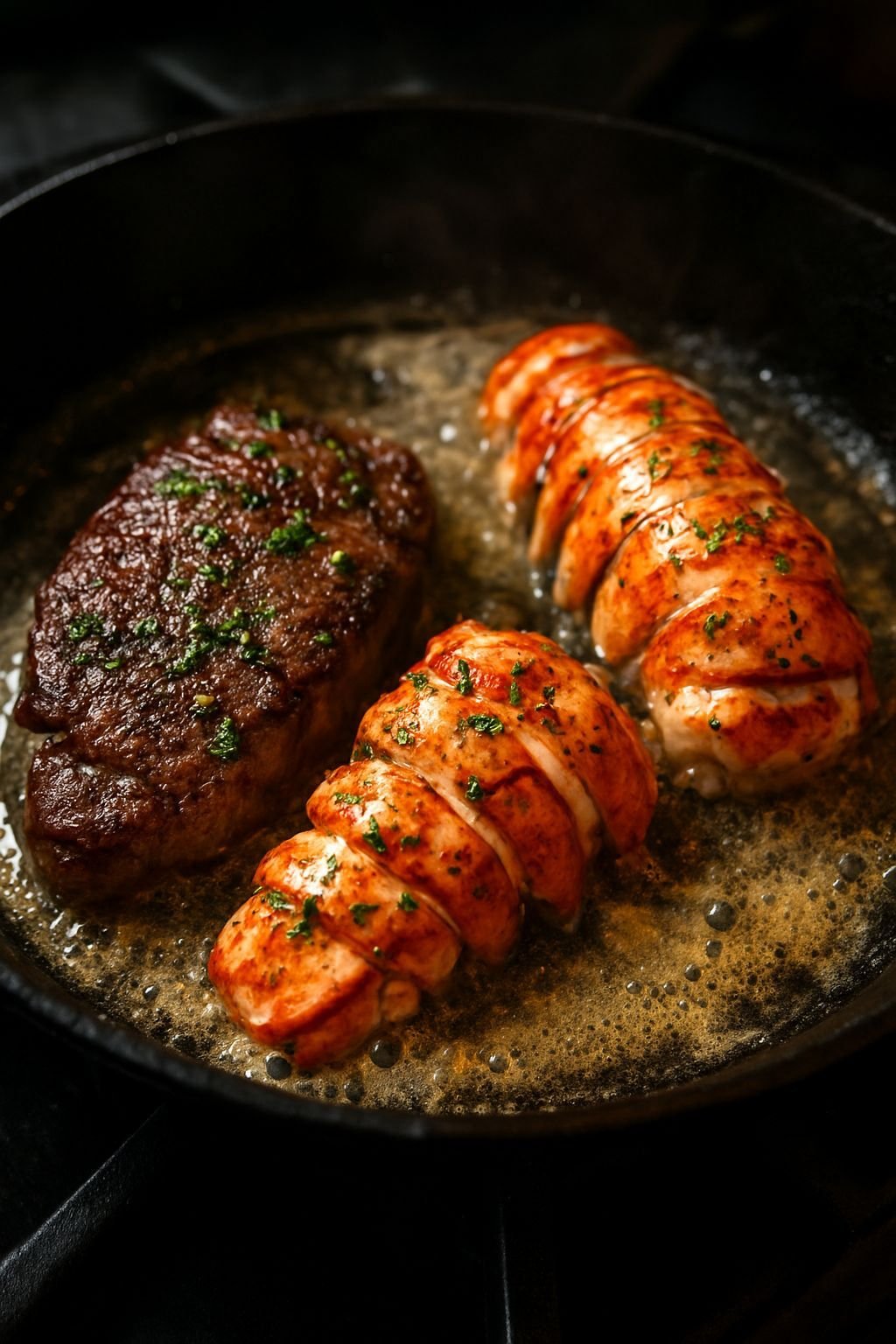
- Sear the steaks — 6–10 minutes (depending on desired doneness). Place the steaks in the hot pan and press gently to ensure full contact. Sear without moving for 3–5 minutes per side for medium-rare depending on the pan and steak thickness (1-inch steaks). Flip once, sear the second side, and add 1 tablespoon of butter to the pan near the end. Spoon the melted butter over the steaks for 30–60 seconds to baste and build flavor. Chef tip: Use an instant-read thermometer: 125–130°F for rare, 130–135°F for medium-rare, 135–145°F for medium. Remove the steaks 5°F lower than your target — carryover cooking will raise the internal temperature while resting. Transfer the steaks to a plate, tent loosely with foil, and let rest 5–8 minutes before serving.
- Cook the lobster — 4–6 minutes. After removing the steaks, lower the heat to medium. Add the remaining butter (about 1 tablespoon) to the same pan and let it foam. Add minced garlic and cook 15–20 seconds to bloom the aroma, then place lobster meat-side down in the pan. Sear for 2–3 minutes until the underside gets a touch of color. Flip and baste with garlic-parsley butter until meat is opaque and firm to the touch (internal temperature 140–145°F for lobster). Chef tip: Lobster cooks very fast — monitor closely and rely on opacity and texture rather than timing alone. Overcooking turns lobster rubbery.
- Make the finishing garlic-parsley butter sauce — 1 minute. With the lobster removed, lower the heat, add the final tablespoon of butter, a pinch more salt if needed, the chopped parsley, and a squeeze of lemon if using. Stir to emulsify into a glossy sauce. Spoon this sauce over both the lobster and steaks just before serving. Chef tip: If your pan has browned bits (fond), deglaze with a splash of white wine or a tablespoon of water before adding the last butter to capture all those flavors.
- Plate and serve immediately. Slice the steaks against the grain if desired, place lobster tails alongside, and finish with parsley and lemon wedges. Serve with roasted vegetables, a simple salad, or a light starch like herbed potatoes for balance. Chef tip: For show-stopping plating, lift a few strands of microgreens or watercress and tuck a butter-poached garlic clove beside the proteins.
Practical chef tips & pro techniques
- Dry and hot: Pat proteins dry and preheat your pan. Dry meat = crust; hot pan = Maillard reaction.
- Butter basting: Add butter near the end of the sear and tilt the pan to spoon warm butter over the protein for glossy flavor without burning the butter.
- Carryover cooking: Remove steaks 5°F before the target temp; resting distributes juices and finishes cooking.
- Use an instant-read thermometer: It removes guesswork for both steak and lobster.
- Don’t crowd the pan: Cook in batches if needed — overcrowding drops the pan temp and prevents searing.
Nutritional benefits and health considerations
Making Butter Seared Lobster and Steak at home allows you to control portion sizes, salt, and fat — so you can keep this indulgent meal aligned with your nutrition goals. Here’s a data-driven look at the nutritional profile and health advantages of the key ingredients, with an approximate per-serving estimate.
Estimated nutrition per serving (approximate)
- Calories: ~500–650 kcal
- Protein: ~40–55 g
- Fat: ~30–40 g (saturated fat will vary with steak cut and butter)
- Carbohydrates: < 2–4 g
- Key micronutrients: Vitamin B12, iron, selenium, zinc, phosphorus
Notes on the estimate: two 6-ounce lobster tails and two 4-ounce steaks are divided between two people. Exact numbers vary with the steak cut (ribeye is higher in fat), whether you use clarified butter or oil, and the amount of butter absorbed during cooking. Use nutrition calculators with your exact brand and weights for precise values.
Health advantages
- High-quality protein: Both lobster and steak are excellent sources of complete protein that support muscle repair and satiety.
- Micronutrients: Steak provides heme iron and vitamin B12, crucial for red blood cells and energy. Lobster provides selenium and zinc, which support immune function and antioxidant protection.
- Omega-3s: Shellfish like lobster contain heart-healthy omega-3 fatty acids, though in smaller amounts than oily fish.
- Controlled fat and sodium: Cooking at home lets you reduce added salt and adjust butter amounts to limit saturated fat.
Dietary cautions
- If you’re watching cholesterol or saturated fat intake, choose a leaner steak cut (sirloin or tenderloin) and reduce butter or switch to olive oil.
- If you have shellfish allergies, do not substitute lobster with other shellfish without verifying cross-reactivity; choose beef-only or plant-based proteins.
Cost comparison and savings
Surf & turf at restaurants often commands a premium. Here’s a rough cost comparison to show why cooking at home is economical:
- Restaurant surf & turf (per person): $40–80+ depending on venue.
- Home-cooked version (serves 2): Lobster tails $16–40 (total), steaks $12–20 (total), butter/seasoning $2–4 — total roughly $30–64, or $15–32 per person depending on market prices and cut selection.
Buying on sale, choosing sirloin, or using frozen lobster tails lowers the cost further while preserving great flavor.
Variations and alternative cooking methods
Adapt this recipe to different diets, equipment, and occasions without losing the essence of a buttery, seared surf & turf.
1. Grill method (outdoor or indoor grill)
- Preheat grill to high (450–500°F). Oil the grates. Sear steaks 2–4 minutes per side for medium-rare depending on thickness. For lobster tails, place shell-side down; cook 4–6 minutes until meat is opaque. Baste with melted butter off direct heat.
- Pro tip: Use a grilling plank for lobster for a smoky finish.
2. Broiler method (if no heavy skillet)
- Sear steaks quickly in a hot pan just to color, then transfer to a preheated broiler (6 inches from heat) to finish to desired temperature. Broil lobster tails meat-side up for 4–6 minutes, finishing with a quick butter baste under the broiler for gloss.
3. Air fryer method
- Preheat air fryer to 400°F. Season lobster tails and steam briefly with a touch of oil or butter. Cook 6–8 minutes until opaque. For steak, use the air fryer for a quick finish after searing or use it for thinner cuts for 6–8 minutes depending on thickness. Monitor closely.
4. Sous-vide finish (precision method)
- Cook steaks sous-vide to your target temp (e.g., 129°F for medium-rare) for 1–2 hours, then sear quickly in a screaming-hot pan. For lobster, sous-vide at 140°F for 20–30 minutes, then finish with a quick sear or blow-torch to color. This yields precise doneness.
5. Dairy-free and vegan alternatives
- Replace butter with high-heat oil (avocado) or vegan butter. Replace lobster with grilled king oyster mushrooms or large marinated and grilled tofu for texture. Use umami-rich marinades (tamari, miso, mushroom powder) to recreate savory depth.
6. Low-sodium or heart-conscious adjustments
- Reduce added salt, use herbs and citrus for brightness, choose lean steak cuts, and cut butter amount in half or substitute with olive oil mixed with a small knob of butter for flavor.
Common mistakes and how to avoid them
Even experienced home cooks can stumble on surf & turf. Here are typical errors and practical fixes.
- Mistake: Not preheating the pan. Fix: Heat for 2–4 minutes until very hot. A cool pan yields steaming not searing.
- Mistake: Cooking wet proteins. Fix: Pat dry with paper towels until surface moisture is gone for a clean crust.
- Mistake: Overcooking lobster. Fix: Remove lobster as soon as meat is opaque and firm; an instant-read thermometer helps (140–145°F). Lobster continues to firm if overexposed to heat.
- Mistake: Cutting steak too soon. Fix: Rest the steak 5–8 minutes under foil to redistribute juices so slices stay juicy.
- Mistake: Crowding the pan. Fix: Cook in batches. Overcrowding drops temperature and prevents crust formation.
- Mistake: Burning butter. Fix: Use a splash of high-smoke oil first, then add butter late in cooking; or use clarified butter/ghee.
Storage, reheating, and make-ahead tips
Storage
- Refrigerate leftovers in airtight containers. Steak leftovers can keep 3–4 days; cooked lobster is best within 1–2 days for optimal safety and quality.
- For longer storage, freeze components separately: steaks vacuum-sealed or double-wrapped in freezer-safe bags for up to 3 months; lobster meat sealed and frozen up to 3 months. Thaw in the refrigerator before reheating.
Reheating
- Steak: Low-and-slow is best. Preheat oven to 250°F, place steak on a wire rack over a baking sheet, and warm until internal temp is about 110–120°F (10–20 minutes), then quickly sear in a hot pan for 30–60 seconds per side to re-crisp the crust.
- Lobster: Use gentle reheating to prevent rubberiness. Wrap in foil with a small pat of butter and warm in a 275–300°F oven for 8–10 minutes; alternatively, steam briefly over simmering water for 2–3 minutes.
- Microwave: Avoid microwaving to preserve texture and avoid uneven heating. If used, keep power low and check frequently.
Make-ahead strategies
- Prepare garlic-parsley butter in advance and refrigerate or freeze into pats; melt and spoon over proteins when serving.
- Pre-split lobster tails the day before and keep refrigerated tightly wrapped.
- Season steaks in advance and refrigerate uncovered for a dry brine (up to 24 hours) to deepen flavor and improve crust formation — then pat dry before cooking.
- For entertaining: sous-vide steaks until slightly underdone, refrigerate, then finish with a hot sear just before serving for fresh-crisp results without rushing the stovetop.
Plating and sides suggestions
Balance richness with brightness and texture contrast. Try these pairings:
- Light lemony arugula salad with shaved Parmesan and a citrus vinaigrette
- Roasted baby potatoes or fingerling potatoes with thyme
- Garlic butter green beans or asparagus
- Simple herbed rice or creamy cauliflower mash for low-carb option
- Sauce suggestions: compound herb butter, lemon-butter sauce, or a light white wine and shallot pan sauce
Conclusion — key takeaways and encouragement
Butter Seared Lobster and Steak is an achievable, impressive meal at home: solid technique (dry, hot pan, proper seasoning, butter basting) delivers restaurant-quality results without complicated steps. By controlling heat and timing, you preserve tenderness in the steak and sweet, succulent lobster meat. The recipe is flexible: adapt it to grills, ovens, air fryers, or sous-vide for different outcomes and dietary needs.
Try this recipe tonight: pick one swap (leaner steak, dairy-free butter, or grilled finish) and make it your own. Share a photo and note what you adjusted — I’d love to hear which method gave you the best crust or the juiciest lobster. Cooking surf & turf at home is as much about technique as it is about enjoying the process.
FAQ — quick answers to common questions
- How do I know when the lobster is done? Look for opaque, white meat with no translucent sections and a firm texture. Use an instant-read thermometer if unsure — 140–145°F is a reliable target. Cooking times are short, so watch closely to avoid rubberiness.
- Can I use frozen lobster tails? Yes. Thaw them overnight in the refrigerator, pat them thoroughly dry, and follow the same searing procedure. Buying vacuum-packed frozen tails is often more economical and still very flavorful.
- What if my steak is too thick or too thin? For thick steaks (>1.5 inches), sear both sides then finish in a 400°F oven until target temp. For thin steaks (<3/4 inch), reduce sear time and watch for rapid cooking; consider cooking them entirely on the stovetop with a quick high-heat sear.
- Can I prepare this ahead for guests? Yes. Pre-split lobster tails, make compound butter ahead, and dry-brine steaks up to 24 hours. For ultimate convenience, sous-vide steaks earlier, refrigerate, and sear just before serving; reheat lobster gently in the oven or steam right before plating.
- What’s the best way to avoid burning the butter? Use a mix of a teaspoon of neutral high-heat oil and butter, add butter late in the searing process, or use clarified butter/ghee which tolerates higher heat with less burning.
Enjoy your Butter Seared Lobster and Steak — a simple set of techniques turns premium ingredients into an unforgettable meal. If you try it, please share your notes on doneness, substitutions, and plating — and pass this recipe on to friends who deserve a special dinner at home.